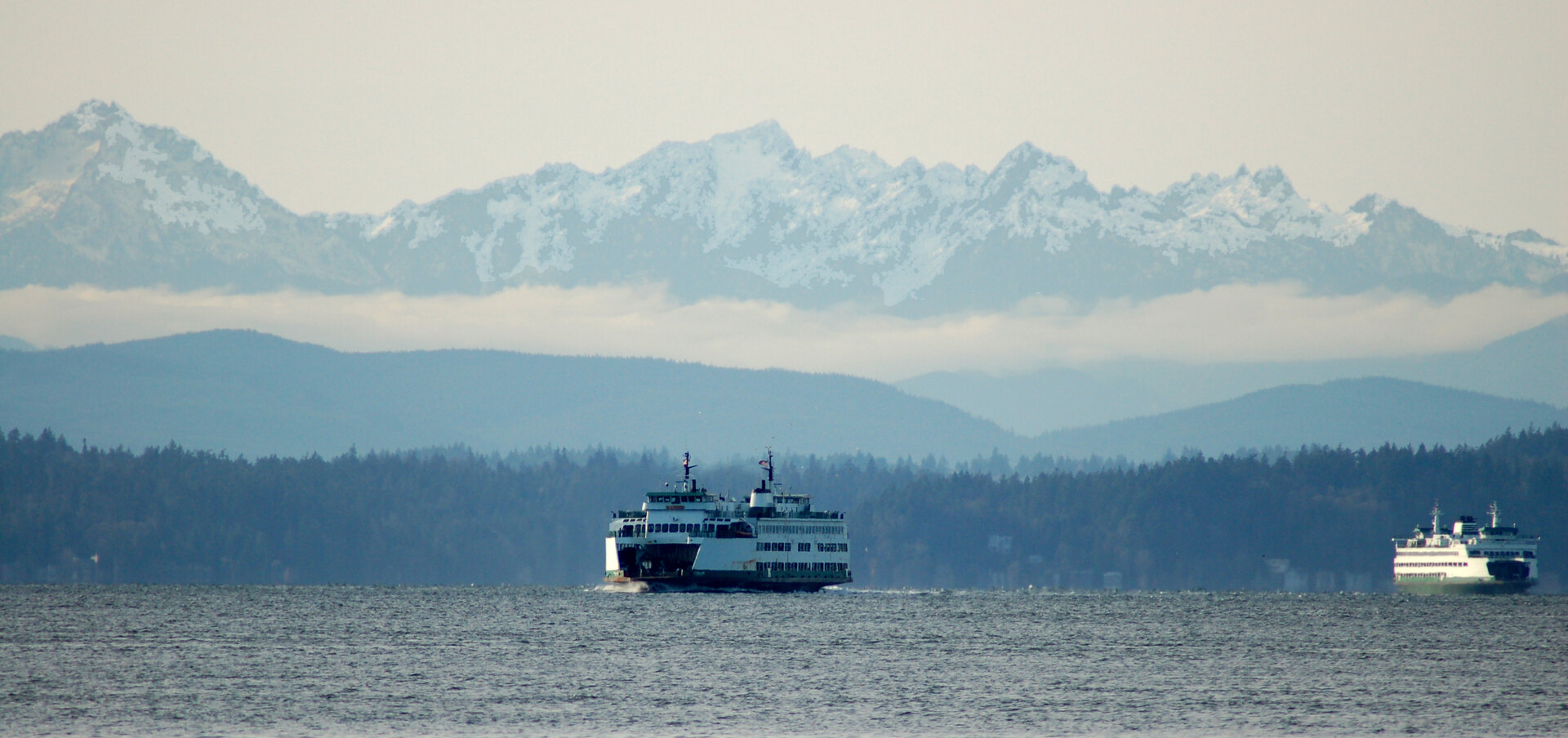
Internet for ferry routes.
Geoduck GigaNet is developing a managed ferry connectivity service for the Salish Sea. Every project starts with a vessel and route assessment.
Hero and social image: Grace from Seattle / GraceMarcellaNorman, Wikimedia Commons, CC BY 2.0. Cropped/resized. Photographs show the region, not customers or endorsements.

Who we serve
For the crossings people count on.
Public ferry systems and passenger operators come first. Riders want to send a file, join a call or check the next connection mid-crossing. Crew need a network kept apart from the public one.
- Onboard Wi-Fi planned deck by deck
- Separate rider and crew networks
- Monitoring and reporting scoped upfront
- Funding model set by the operator
Rider network
A captive portal with your terms of use, content filtering set to your policy, and a sign-in page that works with screen readers and large text.
Operations network
Crew, wheelhouse and vessel systems stay on an isolated network with separate credentials, so rider traffic never shares their path.
Comparison
Cellular, satellite, or both?
A rider's phone hotspot and commercial onboard cellular are different things. Roof antennas and commercial gear can outperform a phone, depending on the route. Neither option guarantees speed or zero dropouts.
Coverage
- Onboard cellular Wi-Fi
- Good where the route stays within carrier coverage. Can fade mid-channel or behind islands.
- LEO satellite + cellular backup
- Adds a path independent of shore towers, but antennas need a clear view of the sky.
Busy-sailing capacity
- Onboard cellular Wi-Fi
- Shared with the carrier network. Fine on many routes; depends on local tower load.
- LEO satellite + cellular backup
- Shared satellite capacity, not exclusive bandwidth. Sized to the vessel either way.
Latency
- Onboard cellular Wi-Fi
- Usually low where the signal is strong.
- LEO satellite + cellular backup
- Generally suits calls, but not automatically lower than good cellular.
Redundancy
- Onboard cellular Wi-Fi
- One path type. Multiple carriers can help.
- LEO satellite + cellular backup
- Two independent paths, with failover when one is available.
Costs and installation
- Onboard cellular Wi-Fi
- Can be simpler and cheaper where coverage is good.
- LEO satellite + cellular backup
- More equipment, service fees and roof work.
Cellular stays the cheaper choice where coverage is solid. Routers with two or more carriers can bridge gaps one network misses, but each plan adds a monthly cost, and no carrier covers water it cannot reach.
Satellite adds roof mounting, cabling, power and a service plan. Masts, stacks and terminal structures can block the sky. Peak ridership, handoffs, obstructions, weather and both options are checked on the actual route before anything is recommended.
How it works
Three steps, one vessel first.
Step 1
Assess
We ride the route and walk the decks with your crew. Steel bulkheads block Wi-Fi, so access point placement follows the real layout. We map cable routes, available power and mounting space, and log signal along the crossing. Your team tells us about peak sailings, maintenance windows and IT rules.
Step 2
Plan
You get a written design with costs, assumptions and acceptance criteria: what coverage, capacity and uptime will be measured, and how. Monitoring, response expectations and reporting are agreed before any work starts.
Step 3
Pilot, then decide
Install on one vessel, scheduled around sailings and layups. Then measure on real crossings: busy sailings, handoff interruptions, dead spots. Results are compared with the acceptance criteria before anyone talks about a fleet.
Source note, October 29, 2026
Washington State Ferries says passenger Wi-Fi has launched on the Chimacum, normally on Seattle/Bremerton, with the strongest signal inside the passenger cabin and a review after year end. WSF described a cellular-first approach in January reporting, noting commercial antennas are stronger than phone hardware. No final results are reported in these sources. Geoduck is an independent proposal, not a WSF partner.
FAQ
Straight answers.
- Can we start with one vessel?
- A one-vessel pilot keeps the scope manageable. Agree the trial length and acceptance criteria before deciding whether to expand.
- Will every rider get fast internet?
- No one can promise that. Capacity is shared, and speed depends on ridership, coverage and conditions. The design is sized for your busiest sailings, and the pilot measures what riders actually get.
- How is the crew network protected?
- Rider traffic is kept separate from crew and vessel systems, set up to your IT policies.
- Who pays for rider Wi-Fi?
- The operator decides. Options to discuss include free access as a public amenity, a link to fare products, or a free tier with an optional upgrade. Nothing is tied to fares today; it is a scoping question.
- How would a public agency buy this?
- Scope, deliverables and pricing are written so they can fit your procurement process, whether that is a small pilot purchase or a formal solicitation.
Contact
Talk with Tyler
Tyler Nix would like to hear about your vessel, your route and what riders need on board.